

With 2024 coming to an end and the start of 2025 reminding the world of the ever-rising issue of our world’s sustainability. The Sustainable Development Solutions Network of the United Nations has summarized the data gathered on world sustainability in its yearly report, providing crucial metrics for the world’s progress toward sustainability. Although the scope of this read will be on environmental sustainability, it is important to note that environmental sustainability is closely tied to other of a nation or region conditions and policies and that ecological sustainability is not an independent issue but involved in a complex web of public policy and scientific implementation. Putting environmental sustainability at the focus while comparing and utilizing other metrics, such as GDP, can allow us to make informed and reasonable conclusions without disregarding factors beyond the scope of environmental sustainability.
Sustainable Development Goals Index Scores
The Sustainable Development Goals(SDG) Index Scores are the UN’s way of gauging a country’s progress toward meeting the SDGs set by the UN. This score is calculated by converting key metrics of each of the 17 SDGs, such as GHG emissions or life expectancy, to an index value out of 100, then averaging all of those values across the 17 goals to find the country’s overall SDG index value. Ranking each country’s average index score shows that Finland is first at a value of 86.4 So, and Sudan ranks last at 40.1, with the global average being 66.3. These scores show that the world is generally on an upward trend toward sustainability, but extremely slowly.
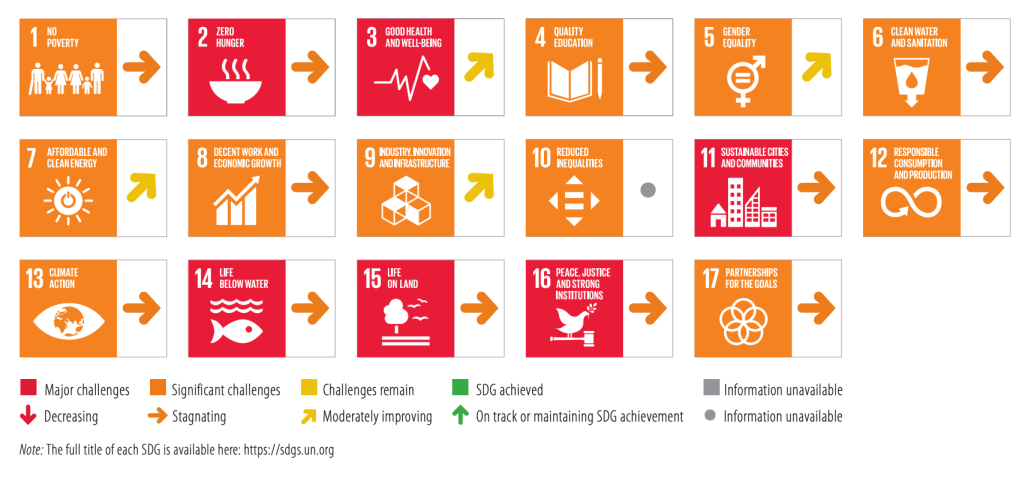
This figure shows the general overview of the world’s progress towards meeting the UN’s SDGs, showing that there is limited to no progress toward attaining the SDGs by 2030. The caveat is that although not much progress is being made with the world, many countries are making significant progress or have already met the goal, showing that certain countries are making considerable progress toward the SDGs even though progress is minimal when averaged out over all countries.
Issues With Scoring
Although these index scores are valuable for gauging progress and can highlight areas for improvement in a country, they can also be easily misinterpreted or taken out of context. This is because, with each of these metrics, the country’s situation, financial stability, and locality are not taken into account. Many countries are unable to meet the UN’s SDGs due to these factors. This is seen through the fact that nearly all developing countries are in the bottom half of the index score rankings, highlighting how the ability to progress toward sustainability is closely tied to the preexisting requirement of the stability and prosperity of a nation. This shows how complex of an issue sustainability is and that in achieving sustainability goals, we are not only improving the environment and the long-term success of our society but also solving many of the chronic issues that plague countries, like poverty and financial turmoil. This is because only after countries secure their present-day success can they begin to work on guaranteeing their future and focus on other long-term risks, such as climate change.
 The Green Analysis
Leave a comment